This hardcover picture book harkens back to the post I did earlier about picture books for adults (Part I is posted, Part II is coming soon). Published by Clarion Books just last year in 2009, everything about this book screams "made for an adult audience here!". From the sophisticated collage-style, often abstract artwork (not that children can't also appreciate, understand, and create this type of artwork) to the free verse, deep though poetry about various types of jobs adults have, I can't really imagine children under the age of 12-14 enjoying this book in the "Can we read that book before going to bed?" sort-of-way.
That said, not being a child any more myself (despite whatever my parents may tell me), I greatly enjoy this book and keep a copy above my desk at work. Not only is the cover illustration inspiring, but if I need some inspiration, it's fun to take a 2-minute break and read about what someone else may be doing for work right that very minute, say as a Dog Walker, Filmmaker, Personnel Administrator, or even:
Writer
Paid daydreamer
imaginary soothsayer
odd-fact researcher,
the writer
hovers like a hummingbird
by the
answering machine
computer
mailbox,
holding her breath while
scanning e-mails
listening to messages
sifting through junk mail
waiting, waiting,
forever waiting,
for the next
check
project
or call.
The artwork, in particular, is what draws me to this book, especially the displaced ISBN/barcode on the back cover. I love collage-style art, and also am a huge fan of this illustrator duo, who have numerous other picture books together. Going back to my earlier point about the "sophisticated, often abstract artwork", just to emphasize how much children can appreciate it, this duo has co-illustrated one of my favorite high concept picture book series: Trains (9780761455936, Marshall Cavendish, $6.99), Cars (9780761456162, $6.99), Airplanes (9780761453888, $14.99),Trucks (9780761453284, $6.99), and Boats (9780761455240, $17.99).
Having some experience with sales figures from my previous career as the children's book buyer for the Odyssey Bookshop, it was useful to bring my own knowledge of the bookselling world to the sales information gathered from the publishing world. Book awards like the Newbery, the Caldecott, the Coretta Scott King, and the Pura Belpre are awarded by the American Library Association through the Association for Library Service to Children. When looking at sales figures, in order to understand them, one must have some understanding of the influence and intersection of three separate communities: the library market, the publishing market, and the bookselling market.
Publishers publish a book, doing all the first-tier work: editing, creating an attractive package, sales and marketing promotion and events, etc. Booksellers do the second tier work: showcasing the books available for purchase in-store, on websites, hosting author events, writing reviews, furthering the sales and promotion begun by the publishers, and also often working with schools to partner on making the book available for educational purposes. Libraries are the third tier: making the book available to a non-book-buying audience, also holding author and book events, also furthering the publisher promotion, but then increasing the school/education element, as well as often discussing the book in a more academic context. All three tiers have their own wide reaching, and often overlapping, spheres of influence, and all three tiers will often evaluate the book within the children's literature canon as a whole.
How is this reflected in sales? Well, remember Venn diagrams? Same concept: the book wants to have as much of the publishing, library, and bookselling market overlap as possible. But, because these are three separate entities, there's no guarantee they're all going to agree. Obviously the publisher is going to be gung-ho about their books, but each book receives a different amount of promotion. Then, the ALA might love a book and honor it with an award, but it turns out to be a book more suited for the library (read: book-borrowing) market, rather than flying off the book store shelves. Conversely, booksellers may love a book and elevate it to a higher sales status than one afforded by publishing promotion, but that still doesn't guarantee it a spot on the ALA best list - or it could, as with the case of recent Newbery winner When You Reach Me by Rebecca Stead.
Now, the neatest part about this project was that there were several books on my list that had been published prior to 1990 (as you might imagine). Specifically two titles - one published in 1970, another in 1976 - did not have sales information available through any HMH computer database. This is because these titles are currently out-of-print, meaning though they won awards, they fell into that category of library appreciation, not bookselling appreciation, and so have fallen out of popularity. The tricky part is that they went out-of-print before the time when records began being recorded in a computer database. This means I got the help of a very nice gentleman in the sales department who kindly looked up and photocopied for me the original recipe card sales records of these books, hand entered, from about 1970-1981 (for the two books combined).
How cool is that?
I got to sit here, holding these photocopies of ancient (okay, I know the 1970s was not an ancient time) records, adding up the numbers by hand (okay, on the calculator on my computer), because they were not in a computer database. Before all of you who remember the '70s start lambasting me for making fun of something 40 years old, the point is I LOVE moments like this, when I feel so connected to a history and a time before the current digital age. (I wish I could scan the photocopy of the card to show, but that would involve revealing sales figures and I don't want to risk that.) So, despite my slight exaggeration in tone, I'm actually very appreciative and excited that I had this experience today.
Going through the slush pile a few weeks ago, I came across an artist who layers photographs and clipart pieces to create ethereal digital collage artwork. I wish I could show them to you, but unfortunately the artist doesn't have a website. While the project wasn't right for Houghton Mifflin, the illustrations were beautiful, and for me, immediately brought to mind the song used in this video:
(The song is Strange Love by Little Annie, and it's eerie, and a little weird, and I love it. If you want to hear the whole song, click here, though I have to warn you that the typewritten lyrics on the YouTube video are a little off.)
I could envision full-color, full-bleed pictures adding their surreal quality to the already haunting lyrics. Of course, with the heavy, sexy lyrics and accompanying illustrations, this picture book is more appropriate for adults than children, and that thought made me consider the concept of picture books intended for adults as a whole.
The picture book that immediately came to mind was Griffin and Sabine: An Extraordinary Correspondence (9780877017882, $19.95, Chronicle) by Nick Bantock. There are four books in this series that is a mysterious love story between two people named Griffin and Sabine, spanning continents and time continuums. Each book contains gorgeous hand-designed postcards and letters between the two lovers as they unravel the mystery of their romantic communication. Perfect for fans of The Time Traveler's Wife by Audrey Niffenegger, though not quite as dark.
Speaking of Audrey Niffenegger, she has created several picture books for adults: The Adventuress (9780810970526, $27.95, Abrams), The Night Bookmobile (9780810996175, $19.95, Abrams), and The Three Incestuous Sisters (9780810959279, $27.95, Abrams). In keeping with the classic Audrey Niffenegger style, these picture books are dark and fantastical while exploring complex emotions of primarily female characters.
Not all picture books intended for adults are as serious as these. Theodor Seuss Geisel, better known as Dr. Seuss, had quite the naughty side. In addition to writing beloved children's books, Dr. Seuss was also a political cartoonist during World War II; his cartoons have been collected in Dr. Seuss Goes to War (9781565847040, $19.95, Perseus). He also wrote several picture books that are much more adult-themed in nature, including You're Only Old Once!: A Book for Obsolete Children (9780394551906, $17.99, Random House), detailing the hilarious medical checkup one of a certain age might go through, and Seven Lady Godivas: The True Facts Concerning History's Barest Family (out-of-print), a book featuring seven naked ladies romping through tongue-in-cheek explanations of common idioms. Then, of course, there are other Dr. Seuss classics that are favorites to give to adults upon certain graduations and employment transitions, such as Oh, the Places You'll Go! (9780679805274, $17.99, Random House).
Other children's books are often given between adults for various holidays. Two of my favorites make perfect Valentine's Day presents for both friends and loved ones: I Like You by Sandol Stoddard Warburg, illustrated by Jacqueline Chwast (9780395071762, $6.95, Houghton Mifflin) and A Friend is Someone Who Likes You by Joan Walsh Anglund (9780152296780, $9.95, Houghton Mifflin). Both of these offer adorable illustrations accompanying sweet, child-like text celebrating like, love, and friendship. Though those were published as children's books, their full value is understood more by adults, I think, who can better appreciate the nuances of both text and illustration.
This is true for many other children's picture books, whose humor, while appealing to children, is of a particularly cheeky, sarcastic, implied, or ironic nature that is greatly enjoyed by adults. Some of my personal favorites catering to the dual audience are the Knuffle Bunny trilogy, the Pigeon books, and the Elephant & Piggie series created by Mo Willems. A classic of this genre is The Stinky Cheese Man and Other Fairly Stupid Tales (9780670844876, $17.99, Viking/Penguin), hilarious retellings of classic fairy tales by Jon Scieszka, illustrated by Lane Smith. Lane Smith is quite the connoisseur of this type of work, both by discussing children's books in an adult way on his blog Curious Pages, and by creating books of this nature, such as the recent release It's a Book (9781596436060, $12.99, Roaring Brook Press/Macmillan), a book about the introduction of a hard copy book in a digital age.
It's a Book walks that fine line between being really intended for an adult audience but being published in a children's market. There are many picture books published in this vein, such as All My Friends Are Dead(thanks to A. Neff for this!) by Avery Monsen and Jory John (9780811874557, $9.95, Chronicle), just published in June, about all the people, animals, and objects who have deceased friends. I can't think of a single friend who wouldn't snort with laughter at this snarky book.
If at first you don't succeed, try, try again. Let me tell ya - it works!
After literally months of job searching, cover letter-writing, resume-restructuring, informational interviews, actual job interviews, nail biting, and losing sleep, I have an announcement to make:
As of Monday, October 4, 2010, I will be the new Sales Assistant/Receptionist for Beacon Press, located on Beacon Hill, in Boston, MA.
I can hardly believe my good fortune. Not only is Beacon Press located in one of the most beautiful neighborhoods in Boston, but the company itself is such an inspirational institution. Associated with the Universal Unitarian Association, Beacon Press is known for publishing outstanding works of poetry (Mary Oliver is published by Beacon), liberal and thought-provoking works of adult fiction and non-fiction, and most recently some YA graphic novels.
In my position as Sales Assistant/Receptionist, I will be at the front desk, serving as a representative of both Beacon Press and the UUA, meeting & greeting Beacon Press visitors, answering phone and email inquiries, and other sundry receptionist duties. I will also be assisting with the website, online marketing, and coordinating with organizations hosting author events with Beacon Press authors. I'm sure there will be other duties I can speak about later as I settle into the position and find out what they are.
But Rebecca, some of you might be gasping, this isn't editorial work, nor is it related to children's literature!
Good point, but this is an opportunity to work within a small, independent, well-respected publishing company in Boston. This is obviously an entry-level position, and as I have only internship experience within the publishing industry as a whole, I am thrilled to gain full-time employment in the industry. I can learn so much about various aspects of publishing I've never experienced, while also keeping my eyes open for a future position in editorial work. Everyone has to start somewhere, and I am so lucky my publishing career has begun at Houghton Mifflin and now at Beacon Press.
I Ain't Gonna Paint No More!
by Karen Beaumont, illustrated by David Catrow
9780152024888, $16
Despite not knowing the tune to the song "It Ain't Gonna Rain No More," the new lyrics stand on their own as very funny, lively, interactive text, whether you're literally painting or just reading and singing along. A little boy paints all over his house - the walls, the curtains, the ceiling, the floor - so his mother forbids him to paint anymore. The boy gets around this by painting himself while singing this song, with such lyrics as, "Guess there ain't no harm if I paint my...[kids guess as you flip the page] ARM! Now I ain't gonna paint no more." Kids can mime painting themselves while dancing around and signing this song.
If you're reading this at an activity-based storytime, you can have the kids draw an outline of themselves, and then paint in the body like the illustrations in the book. The illustrations are black-and-white outlines with shading; as the little boy paints himself, each body part becomes a riotous mix of colors, shapes, styles, and images. This illustration style really appeals to me, and if it does to you, too, check out Super-Completely and Totally the Messiest by Judith Viorst, illustrated by Robin Preiss Glasser, one of my favorites.
Originally published in 1984, this delightful little book (apparently I have a preference for books with a small trim size) is perfect for the care package I'm sending to my sister at college. Published with a new jacket image and color illustrations for the first time in 2003, each page exhibits spot illustrations of romping sisters, demonstrating how they are alike and how they are not. The most important thing, of course, is that no matter how different they may be, they both love each other a lot. Sweet without becoming saccharine.
Good news on the summer internship front: It has now been extended into a fall internship. Hooray!
Beginning today, for the next 10 weeks (or until I find a full-time position), I will remain the Children's Editorial Intern, now working directly with Kate O'Sullivan, Senior Editor at Houghton Mifflin, as well as with other HMH children's editors, including Margaret Raymo, Ann Rider, Erica Zappy, and editorial assistant Christine Krones. I will continue to read manuscripts and write reader reports, make my way through slush piles, write decline letters, and in general learn more about the Houghton Mifflin way of children's publishing.
Subsequent postings on my experiences will be entitled "What I Learned From My Fall Internship". Also, I hope to continue posting (albeit sporadically) the Houghton Mifflin Harcourt Book of the Day. Lastly, check out Afterfonts..., my blog dealing with things typographical- and word-related, where I sometimes post the new vocabulary words I've learned from all my reading. Occasionally, I also get the urge to make words up, like the word hippoltergeist, a word that came about when I somehow got the words hyperpolyglot and poltergeist mashed together in my head. A fellow intern and I decided hippoltergeist should be defined in this way:
hippoltergeist, n.
-the spiritof a deceased hippopotamus that wreaks havoc on family homes, mainly in the children's bedrooms, though not in a malicious way
Third in the HMH Book of the Day series is... Out of the Egg
by Tina Matthews 9780618737413, $12.95
A retelling of the Little Red Hen, Tina Matthews updates not only the illustrations, but the ending as well. The illustrations depict a mix of country and city elements complete with farm, apartment buildings, cars, computers, and telephone wires, yet the simple woodcuts in black, red, and green maintain the classic feel this tale requires.
For those who don't remember the story, the Little Red Hen finds a seed, plants it, and cares for it. She asks Fat Cat, Dirty Rat, and Greedy Pig for help throughout the seasons, but "Not I," they say each time. "Then I shall [insert task here] myself," answers the Little Red Hen. Over the years, the seed grows into a large tree, providing a safe space for the Red Hen to lay her egg. Soon a little chick appears, as does a little cat, a little rat, and a little pig. When the Red Hen would deny the little cat, little rat, and little pig the chance to play beneath her shady tree, she learns a lesson in kindness from her cheeky little chick.
I don't know if the title is a play on the phrase "out of the mouths of babes," but that's what I always think of when I relate the title to this book, for out of the egg came a little chick and out of her mouth comes true friendship.
Today I want to share two issues I learned about this summer that had not previously occurred to me as problems editors encounter.
The first issue involves an author an editor has worked with before. Say Editor A has published Book B by Author C. Author C's agent then continues to submit Author C's work to Editor A. Unfortunately, none of the work appeals to Editor A as much as Book B did. This could be for any number of reasons - different subject matter, different genre, not as well written, etc. Yet Editor A doesn't want to lose Author C as one of "their" authors. If Editor A continues to turn down Author C's manuscripts, the agent is no longer going to submit them to the editor. This would disappoint Editor A, because Editor A believes in Author C, and thinks Author C is capable of producing another book as good as Editor A thought Book B was. What's Editor A to do?
I was surprised at this situation, having never thought the continued working relationship between editor and author would be anything other than magical (naive, I know). What should/could/would an editor do in that situation? There's no hard-and-fast rule. Anyone in that situation has a number of options, including acquiring a book the editor is not as thrilled with, just to keep the author as one of "theirs" - perhaps they could work on it together to make it more like whatever the editor liked about Book B; not acquire anything and let the author go elsewhere; or perhaps an unorthodox option would be to talk to the author directly to inquire what else the author might be working on to see if there's anything similar to Book B (I thought of this one myself, so I don't know if it would really work).
The second issue is trickier, and is almost more philosophical or ethical than strictly editorial. Let me make it clear that this is a line of questioning I'm pursuing on my own, not in affiliation with any publishing company. In this scenario, Editor A purchased Book B from Author C. Though several people read the manuscript, it wasn't until after acquiring it that someone realized the manuscript for Book B was awfully similar to Movie Plot D. Names, characters, and general themes were changed, but the basic plot points were eerily similar. Now is that plagiarism of ideas or not? And if it is, what should the editor do? Book B is obviously going to be a huge hit for various reasons. To complicate matters, say Editor A has not worked with Author C before; therefore there is no rapport for Editor to say, "Look, Author C, what's up with this manuscript?" What's Editor A to do? Un-acquire Book B, a book that's sure to be a best-seller? Confront the unknown author and risk having Author C pull the project and hand it to a different publisher? Or ignore the similarities and publish it anyway?
I don't have a ready answer to this second issue myself. Does anyone have an opinion on this?
These are two of the major issues that stand out to me as particularly difficult to negotiate, and are probably indicative of the types of decisions editors deal with on a daily basis (though I imagine situation 1 is more common than situation 2, though I don't know for sure). While a part of me can not wait for the day when I have the power to make decisions like these, it is very clear to me that I will need years more experience before I feel comfortable handling a decision like that on my own. I'm very much looking forward to continuing to work my way up to that.
I can hardly believe that one week from Friday, my internship with Houghton Mifflin will be over. Ten weeks wasn't nearly enough time to fully absorb everything, yet I also learned so much from the wonderful editors I've worked with this summer.
Margaret Raymo, Kate O'Sullivan, and Erica Zappy were the Editors "on location" in the Houghton Mifflin Boston office, with the knowledgeable Christine Krones as Editorial Assistant, and the ever-helpful Meredith Wilson as Assistant to the Publisher. Editor Ann Rider also sent me tasks from her home office in Minnesota.
My primary responsibility was to read, read, read - a job with which I had no problem, as you might imagine. I read manuscript submissions for the various editors and wrote reader reports. What are reader reports, you ask? Basically, it's my opinion. How great is that? As I clearly have no trouble stating my opinion, that's pretty much the perfect task for me. What was harder was putting into words the feelings I get from reading manuscripts, both those that appealed to me and those that didn't. What was it I was/was not liking? What about that character was so compelling? Was the dialogue too stilted and unreal? What impressed me about that turn of phrase or plot sequence? Could a paragraph be removed to tighten a scene? I don't know how other interns/editorial assistants work, but nothing seemed too large or too small for me to comment about. Thanks to my MFA and the critical papers I spent the last two years writing, I was somewhat more prepared to describe the answers to these questions using (I hope!) appropriately descriptive language and industry jargon. The hardest part about this? Not knowing if or when I might see the books I liked in print. It IS thrilling, though, to know that at least a few manuscripts I liked were acquired during the time I was at HMH. Sometime in the next few years, I'll be able to pass a bookstore shelf and smile, knowing I'd read the manuscript version years prior.
Other fun editorial tasks I learned included how to write decline letters, catalogue descriptions, and flap copy. For decline letters, I learned never to send them right before a major holiday - even if it clears off my desk, the recipient won't be so pleased. I also learned to say something nice before making a suggestion, much like operating within a writing group structure. Lastly, personal to me, I had to learn to change my tone - I was sounding too condescending (shocker!). Catalogue descriptions are comprised of a one-liner sell-line, a short descriptive paragraph, and maybe an excerpt from the book. This all goes into the catalogue publishers put together to give to their reps who sell to bookstores and other retail accounts. As for flap copy, in April 2011, go take a look for The Adventures of Sir Gawain the True, Book 3 in the Knights' Tales series by acclaimed Arthurian author Gerald Morris, illustrated by Aaron Renier (9780547418551, $14.99). On the cover of the book, on the inside flap, should be printed my synopsis/description of the tale. Book 1 is pictured here; this series has been approved by the eight-year-old boy in the household I live in.
Last, but certainly not least, I also got to go through slush piles. Confession: this was my favorite part, second only to reading the actual solicited manuscripts. Slush piles are unsolicited manuscripts, sent to Houghton Mifflin by hopeful would-be authors who have not made a personal contact with any of the editors. Houghton Mifflin is one of the few publishers that still accepts unsolicited manuscripts; most publishers prefer that potential authors work through agents. The slush piles were my favorite because it was like a treasure hunt AND a project I got to organize at the same time. My fun-loving, slightly-OCD self was in heaven. What's even more exciting is that one of the picture books I plucked from the slush pile might get picked up by HMH! Nothing for sure yet but an editor is taking a second look at it. I have daydreams of helping an unknown author get their work published to the joyful satisfaction of us both. I can't help it; I'm an idealist.
Those are the major day-to-day tasks I work on. Stay tuned for the next installment of "What I Learned From My Summer Internship," when I will be discussing unexpected (by me) issues that editors come across.
Oh, the other thing I get to do? Go out for after-work-drinks with my fellow interns (and co-workers).
Today will actually be a mini-ode to the author/illustrator genius of husband-and-wife team Audrey and Don Wood who publish a lot of work with Houghton Mifflin Harcourt.
King Bidgood's in the Bathtub
Hardcover: 9780152427306, $17
Paperback: 9780152054359, $7.99
A Caldecott Honor-winner, this book is a true delight to both read and look through, as there is so much happening in the illustrations that you'll want to spend forever discussing each page. Quirky rhyming at its best, this story is about King Bidgood who won't get out of the bathtub.
"Help! Help!" cried the Page when the sun came up.
"King Bidgood's in the bathtub, and he won't get out!
Oh, who knows what to do?"
The people of the court including the Queen, a Knight, and a Duke suggest various amusements to tempt the King out of the tub, but none of them work. All of the suggestions are adapted to working within the tub. Much hilarity for the readers ensue, while the poor Page has to run around not knowing what to do until FINALLY at the end of the day, he figures out a way to force the King out.
You'll find a similar depth of illustration in this picturebook, but a little less light-hearted story. Sunday, Monday, Tuesday, Wednesday, Thursday, Friday, and Saturday are seven children told by their mother to not let any strangers in and don't touch fire while she goes to the market. She intends to bring back something for each one of them, but while she is gone, a clever witch convinces the children to open the door, light her pipe with sticks from the fire, and then turns them into food. When their mother gets back, she must rely on how well she knows her children in order to save them from being eaten by the witch. The illustrations are too bright to really be scary, and the mother is a tremendously loving force to be reckoned with at the end.
Introducing the Houghton Mifflin Harcourt Book of the Day series!
This series is pretty self-indulgent for me, as it combines my intern life at HMH and one of my favorite blogging exercises - a picturebook series.
First up in the series is a book coming out this fall:
Guyku: A Year of Haiku for Boys
by Bob Raczka, illustrated by Peter H. Reynolds 9780547240039, $14.99, Pub. Date: October 2010
Whimsical and kid-friendly, these haikus speak to the little guys about favorite seasonal activities. Acclaimed illustrator Peter H. Reynolds (probably known best for his books Dot and Ish) brings his signature charm to these illustrations, using a muted color-palate of shades of one color per season - greens for spring, yellows for summer, browns for fall, and blues for winter. Children of all races and sizes fly kites, pound cattails to make pretend snow, skip rocks, and play in the stream. My favorite aspect of this book is that almost every scene takes place outside. This is a true celebration of outdoor fun during all four seasons.
Proving these activities can be enjoyed just as much by girls as guys, one of my favorite haikus reminds me of summer nights from my own childhood when my father used to take my sister and me out to tell us about the stars:
"Lying on the lawn,
we study the blackboard sky,
connecting the dots."
This is a perfect book to share on the first day of each new season, and then write your own seasonal haikus. Encouraging notes by the author and the illustrator at the end will help the reader connect with the creators of such a poignant, inspiring book.
Ever have one of those "duh" moments when you wonder why it took you so long to think of that simple, yet brilliant, idea?
Each month at the Odyssey Bookshop, I hand-select books for children signed up for our Gift of Reading Program. Usually a family member or close family friend signs up the child (age infant through teen), and each month I pick out, ring up, gift wrap, and mail out a book chosen specifically for them. The books have usually been recently published (within the last three months or so), and is chosen based on the age of the child, the gender (yes, I take that into consideration, though I do think outside the box) of the child, the reading level, if I know anything about the child's reading preferences, the literary merit of the book, the artistic merit of the book, and of course, my own personal taste.
Why I never thought to blog about my selections before is beyond me. I will now begin to do so, using only age and gender to identify the recipient of the book. Here they are:
April 2010 Gift of Reading Club Selections
(by age)
Baby (months old) female:
Gossie Plays Hide and Seek
by Olivier Dunrea
9780547242965, Houghton Mifflin Harcourt, $13.99
1 yr/o male:
Trucks: A Mini Animotion Book
by Accord Publishing
9780740792007, Accord Publishing, $9.99 I Like Bugs
by Lorena Siminovitch
9780740792007, Candlewick Press, $6.99
Zoo Parade!
by Harriet Ziefert, illustrated by Simms Taback
9781593540142, Blue Apple Books, $8.95
2 yr/o female:
Pepi Sings a New Song
by Laura Ljungkvist
9781416991380, Beach Lane Books (Simon & Schuster), $16.99
Author and illustrator Stephen Gammell's work is known in two very different veins: sassy, whimsical picturebook illustrator and nightmare-inducing, horror illustrator.
My first introduction to his work was through his Caldecott Award winning book Song and Dance Man (9780679819950, Random House, $6.99). I loved having my parents read the story to me, but it was for the illustrations that I flipped through the book again and again. When I became the Children's Department Manager at the Odyssey, there was an established section of award-winning picture books. Song and Dance Man was one of the first books I ordered in for that section.
More recently, I posted about discovering My Friend, the Starfinder by George Ella Lyon (9781416927389, Simon & Schuster, $16.99) and my love of his newest picturebookHow the Nobble Was Finally Found by C.K. Williams (9780152054601, Houghton Mifflin Harcourt, $18).
What I didn't realize until I began researching him is that most people know Gammell as the illustrator for Scary Stories to Tell in the Dark by Alvin Schwartz (9780064401708, Harper, $5.99). I vaguely remember this book from a 3rd grade slumber party where I got so freaked out, I couldn't sleep for days.
It's amazing to me that his picturebook illustrations create such a different mood that until today, I never made the connection between the nightmare-inducing images of my childhood and the exquisitely detailed, beautifully vivid, almost ethereal picturebook illustrations. It speaks to the versatility of Stephen Gammell as an illustrator, as do his two other Caldecott Honor-winning picturebook titles The Relatives Came by Cynthia Rylant (9780689717383, Simon & Schuster, $7.99) and Where the Buffaloes Begin by Olaf Baker (9780140505603, Penguin, $6.99).
Sadly a few of his books are out of print, but here are some favorites, in addition to those already mentioned, still available at your local bookshop:
The Secret Science Project That Almost Ate the School
by Judy Sierra
9781416911753, Simon & Schuster, $16.95
Old Henry
by Joan Blos
9780688099350, Mulberry Books, $6.99
Old Black Fly
by Jim Aylesworth
9780805039245, Henry Holt & Co. (Macmillan), $7.99
I Know an Old Teacher
by Anne Bowen
9780822579847, Lerner Publishing Group, $16.95
Hey, Pancakes!
by Tamson Weston
9780152165024, Houghton Mifflin Harcourt, $17
TheBurger and the Hot Dog
by Jim Aylesworth 9780689838972, Simon & Schuster, $17.99
Airmail to the Moon
by Tom Birdseye
9780823407545, Holiday House, $6.95
As it is National Poetry Month, I would be remiss in not mentioning his illustrations for Dancing Teepees: Poems of American Indian Youth by Virginia Driving Hawk Sneve (9780823408795, Holiday House, $8.95).
Alchemy and Meggy Swann by Karen Cushman
9780547231846, Houghton Mifflin Harcourt, $16
Meggy Swann is crippled at a time when non-able-bodied people were thought to be cursed by the Devil. She must walk with two crutch-sticks to support her weak and twister legs. Her sour disposition doesn't help her make friends, but which came first – the sour disposition or the near constant taunts and torments from those around her?
At the opening of the novel, she has just been shipped off from the only home she's ever known in a country village tavern to live with her father in Elizabethan London. Having never met or heard of her father before, she has no idea what to expect. Neither does he. Neither one are happy with their situation. Meggy is stuck living in a dark, dingy, dirty house with no food or money while her alchemist father spends all his time upstairs in his laboritorium trying to find the secret to turning things into gold and finding the elixir of life.
As Meggy taps into sources of inner strength, she begins to explore London, and in doing that, unexpectedly makes some of her first human friends. She had brought with her to London her best friend, Louise, a large white goose, which unfortunately gets banished soon after they arrive. Roger Oldham, her father's former apprentice-turned-player (as in play-acting), and his troupe led by Mr. Grimm and Mr. Merrymaker agree to keep Louise out of the slaughter house. Besides the merry band of players, Meggy also gets to know a cooper and his son, and a printer and his family.
When her father sells some men arsenic to kill off a baron, Meggy is shocked to discover her father is desperate enough to consort with murderers in order to earn money for his experiments. She comes up with a plan to warn the baron, but without confessing her father's role. Though she succeeds in warning the baron, her father lives up to his bad character and leaves her stranded and homeless in London. Meggy is dismayed, but the biggest shock comes from finding out she has friends who will help take care of her. She goes to live with the printer and his family to take care of the babies and be an apprentice print-maker. The short novel ends with her dancing for the first time in her life, happy among friends, flirting with Roger, and not quite as sharp-tongued as she first was in the beginning.
Though I did not enjoy as much as The Midwife's Apprentice or Catherine, Called Birdy, there is a similar brilliance in how much Karen Cushman can pack into a 150+ page novel. The historical elements are by far the most interesting, and of course, impeccably researched. There's so much factual information packed into this slim book, and enough of a story to interest the young historical fiction enthusiast. The publisher is marketing this book toward ages 10-14, but I think a strong 8 or 9-year-old reader wouldn't have a problem. Not for every child, but I don't believe Karen Cushman fans will be disappointed.
Thank you to Google for reminding me that today is the 205th birthday of Hans Christian Andersen. Google has a five-image series of Andersen's Thumbelina surrounding their logo today. Andersen was a Danish writer and paper-cut artist who not only recorded tales from the oral storytelling tradition (in the style of the Brothers Grimm), but who also wrote his own creations. His fairy tales were published in Europe beginning in the 1830s, but it wasn't until the 1860s that Americans first got a look at them (in an American English edition - maybe they'd seen them before elsewhere, people did travel back then, you know).
A man named Horace E. Scudder worked for an early version of the publishing house we now know as Houghton Mifflin Harcourt, known then as Hurd & Houghton. At that time in children's publishing, children's magazines were becoming a big deal, with many publishers vying for the position of top-circulating, best-illustrated, most-engaging-stories-by-most-famous-authors children's magazine producer. The Riverside Magazine for Young People was first published by Hurd & Houghton in December 1866. Scudder had a close relationship with Andersen and was able to not only publish 17 of Andersen's fairy tales in The Riverside Magazine beginning in 1868, but Scudder also negotiated on behalf of Hurd & Houghton to publish the only authorized American edition of Andersen's stories (thank you to Leonard Marcus's Minders of Make-Believe for this information). Scudder was constantly encouraging Andersen to make the trip across the pond and visit the States, but sadly that never happened.
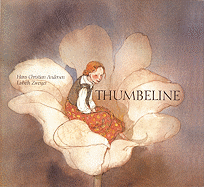
Andersen's tales have been made into movies - cartoon and live-action, plays, and ballets. They also continue to be collected in anthologies and illustrated as individual stories. Just last month in March 2010, Chronicle Books published a version of Thumbelina, illustrated by Sylvia Long (9780811855228, $17.99). One of my favorite versions of this story was illustrated by Lisbeth Zwerger, published under the title Thumbeline (9780735822368, $6.95, NorthSouth). There is even a graphic novel version (9781434217417, $4.95, Capstone Press), and a re-imagined full-length middle grade novel with silhouette illustrations by Barbara Ensor (9780375839603, $12.99, Random House).
Of the hundreds of anthologies of Andersen's work, Lisbeth Zwerger has illustrated a beautiful edition in her signature dreamy watercolor style (9780698400351, $21.99, Penguin). W.W. Norton (a publishing house) has released an annotated collected works (9780393060812, $35), while Calla Editions, an imprint of Dover Publications, has published an immense, bound in a cloth binding with gold embossed lettering, gift edition (9781606600009, $40). Lastly, don't miss a collection of his paper cuttings - artwork that looks like reverse silhouettes, compiled by Beth Wagner Brust for Houghton Mifflin Harcourt (9780618311095, $9.95).
However you prefer your Andersen, illustrated or performed, take some time today or this weekend to read a few of his treasured tales. I'd start with The Little Mermaid (if you're reading with older children or for yourself). This isn't a washed-out Disney version. It's the real classic. As it should be.
A sales rep friend posed this question online today:
I have a writer friend who is looking for YA (or adult) novels that are told in alternating voices. She wants examples where each character has a chapter and they go back and forth between points of view. It’s a bonus if the characters live in different time periods.
The varied responses from the people who answered her, and the fact that I'm working on a YA novel told from various view points, made me reflect on that topic.
A co-worker once lamented about dual-narrator novels, saying something to the effect of, "Unless it's written really really well, it's a cop-out" (I'm paraphrasing greatly here). After I heard her reasoning, I admit I judged dual-narrator novels more harshly, despite writing one of my own.
The way I defend my own writing is that I didn't want to tell the entire novel from a third-person omniscient narrator POV, and both main characters are, ya know, main characters with two distinct voices, so...mine works (I hope).
But what really makes a novel work with multiple voices and in which cases is it unnecessary to the plot? A lot of novels have more than one main character, or really important secondary characters; why should they not all have their own voice? Often scenes are told from the POV of a character other than the main character, but almost never in first person. It is the omniscient narrator that allows the reader to gaze through the eyes of a secondary character, and it abundantly clear that the POV of the primary protagonist is the central focus.
Of course, I'm also confusing this subject by talking about POV (point-of-view), voices, and narrators, and all that doesn't include various storytelling formats such as diary entries, letters, phone conversation transcripts, and the recently more common emails and text messages. Where do all of these fit into the subject of multiple narrators?
While I don't have concrete answers to the questions I've posed, here are some books to hold up as examples for things I think they do particularly well.
My Most Excellent Year by Steve Kluger (9780142413432, $8.99, Penguin) is my go-to favorite for multiple narrator/multiple format storytelling. This is a YA novel about three contemporary teenagers. The novel exhibits three different main character points-of-view, with plenty of secondary characters, texts, emails, IMs, diary entries, and expository scenes.
Another favorite contemporary YA novel that switches not only narrators, but also time periods, is Printz Award-winning Jellicoe Road by Melina Marchetta (9780061431852, $8.99, Harper). Warning: It makes me sob (good tears) every time I read it; it's that good.
A new, not-yet-released YA novel told by dual narrators is Will Grayson, Will Grayson by John Green and David Levithan (9780525421580, $17.99, Penguin, Pub. Date: April 2010). Interestingly, the two different view points are written by two different authors.
My favorite adult novel, though sadly out-of-print, is Letters from an Age of Reason by Nora Hague (9780060959852, Harper). Told in alternating sections, letters and journal entries chronicle the relationship between a white American living in England during the Civil War years, and the high-yellow former slave from New Orleans she falls in love with.
Also told in letters, is a non-fiction book, 84, Charing Cross Road by Helene Hanff (9780140143508, $13, Penguin), which covers the decades of correspondence between Helene, the American author, and the people from the bookstore at 84 Charing Cross Road. Also adult.
Similar to 84... is the best-seller The Guernsey Literary and Potato Peel Pie Society by Mary Ann Shaffer and Annie Barrows (9780385341004, $14, Random House). Also about an American author corresponding with British people, this takes place right after WWII, and delicately showcases the friendships and budding romance. Also adult.
Nora Roberts, also writing as J.D. Robb, often writes scenes from a secondary character's point of view, though it is always clear who the main character is. Her more romantic novels are almost always told primarily through the woman's point of view, but a great strength of her novels are the scenes that are seen through the man's eyes. In her J.D. Robb ...In Death mysteries, not only does the reader see Eve Dallas's and her husband Roarke's POV, but scenes from various victims' POV are often presented as well. For another great mystery, read Darling Jim by Christian Moerk (9780805092080, $15, Henry Hold (MPS)), told from the POVs of a postman, a dead woman and her diary, and a live woman and her diary, among others.
I've noticed YA fantasy novels have a propensity for being told with dual narrators. Here is a quick list of books I've read that showcase dual or multiple narrators that are currently on the store's shelves:
Hearts at Stake (9780802720740, $9.99, Walker & Company (Bloomsbury, MPS)) and Blood Feud (9780802720962, $9.99, Walker & Company (Bloomsbury, MPS)) by Alyxandra Harvey Incarceron (9780803733961, $17.99, Penguin) by Catherine Fisher Leviathan (9781416971733, $19.99, Simon) by Scott Westerfeld Sorcery & Cecelia, or, The Enchanted Chocolate Pot (9780152053000, $6.95, Houghton Mifflin Harcourt) by Patricia C. Wrede & Caroline Stevermer Witch & Wizard (9780316036245, $17.99, Little, Brown & Co.) by James Patterson & Gabrielle Charbonnet
Do you have any examples of novels of this ilk you'd like to share?

 The artwork, in particular, is what draws me to this book, especially the displaced ISBN/barcode on the back cover. I love collage-style art, and also am a huge fan of this illustrator duo, who have numerous other picture books together. Going back to my earlier point about the "sophisticated, often abstract artwork", just to emphasize how much children can appreciate it, this duo has co-illustrated one of my favorite high concept picture book series: Trains (9780761455936, Marshall Cavendish, $6.99), Cars (9780761456162, $6.99), Airplanes (9780761453888, $14.99), Trucks (9780761453284, $6.99), and Boats (9780761455240, $17.99).